

Choosing a Waterproof Coating System for Roofs Wet Areas and Concrete Structures
Learn how substrate, movement, exposure and installation conditions guide the selection of polyurethane, polyurea and cementitious waterproof systems.
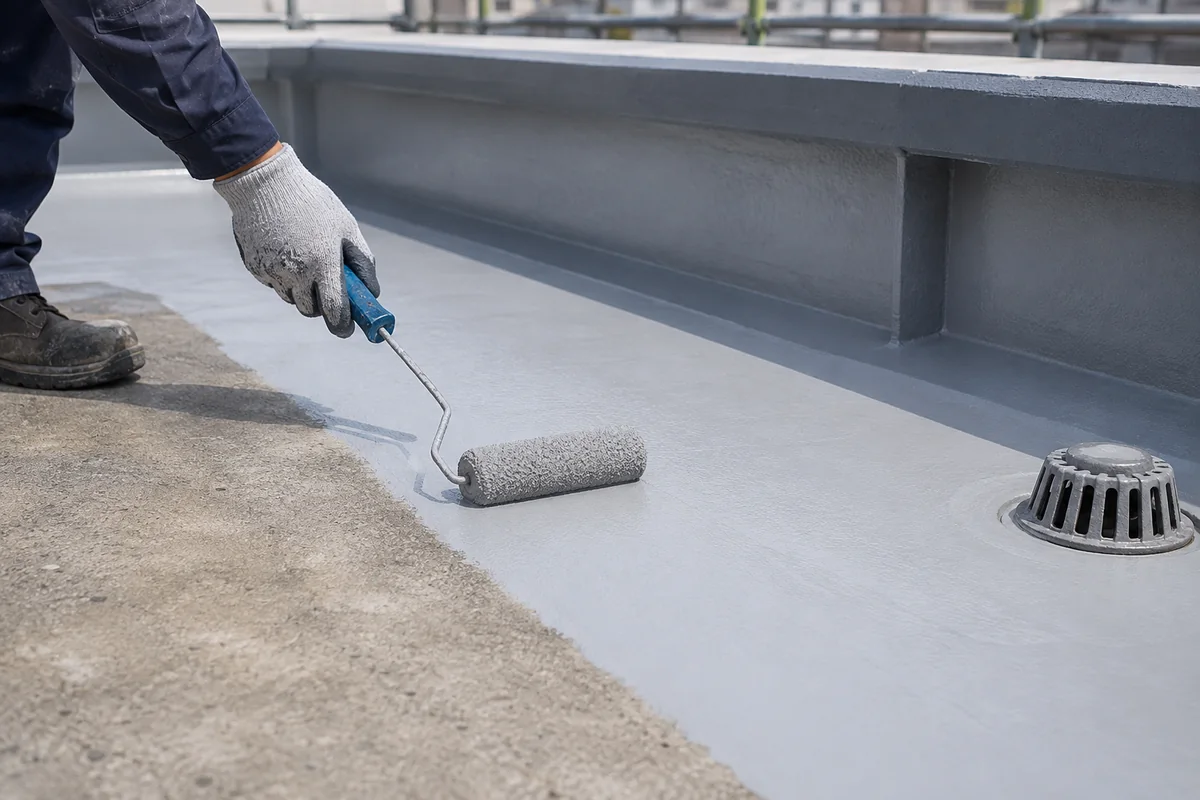
Waterproofing failures are rarely caused by one factor alone. A coating may be technically suitable, but the project can still be compromised by weak concrete, trapped moisture, unsealed details, incorrect thickness or poor curing conditions. A reliable specification therefore connects material choice with substrate preparation, detailing and site control.
Start with the substrate and exposure
Concrete roofs, balconies, basements, pools and industrial floors experience different combinations of standing water, movement, abrasion, ultraviolet exposure and chemical contact. Before choosing a system, document whether the substrate is new or existing, its moisture condition, the expected crack movement and whether the finished membrane will remain exposed or receive a protective layer.
Common waterproofing system families
- Two-component polyurethane waterproof coating forms a continuous elastomeric layer and is commonly considered where flexibility and seamless coverage are important.
- Polymer-modified cementitious waterproof coating is compatible with mineral substrates and can be useful in wet areas or locations that will receive subsequent finishes.
- Polyurea and protective top-coat systems suit projects that require a fast-forming, robust membrane, subject to suitable equipment and trained application.
- Specialty functional top coats can add surface properties to a correctly designed base waterproofing system.
Details determine continuity
Corners, joints, drains, pipe penetrations and transitions between materials deserve separate detailing. These locations concentrate movement and are difficult to cover at a uniform thickness. Reinforcement, sealants, primers or additional coats may be required according to the selected product system and project design.
Control the installation sequence
A practical quality plan should include substrate acceptance, environmental limits, mixing ratios, pot life, coverage rate, wet-film or dry-film thickness, recoat windows and curing time. The applicator should also keep adjacent work away from the membrane until it is ready for inspection or protection.
Waterproofing should be specified and installed as a complete system—from the prepared substrate to the final protected surface.
Huacheng offers polyurethane, polyurea and polymer-modified cementitious waterproof products for different construction conditions. Share the substrate, exposure and application method with the technical team to narrow the selection before testing or site use.